Gloriously Unproductive: How Young Americans Fell Back in Love With Doing Things That Don't Matter
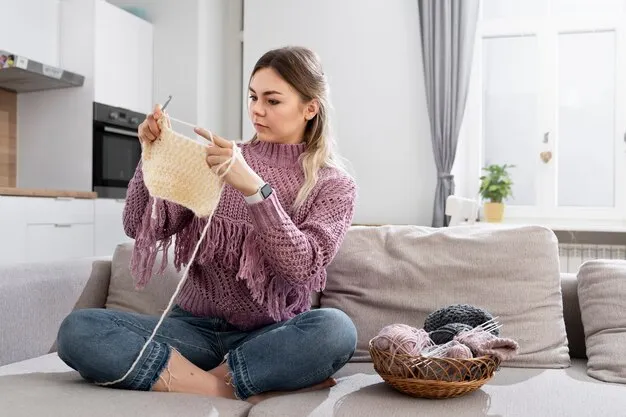
Photo: young woman knitting at home cozy weekend hobby relaxing, via img.freepik.com
There's a 26-year-old in Brooklyn who spends her Sunday mornings building scale models of mid-century diners. She doesn't post them. She doesn't sell them. She barely even shows them to friends. When asked why she does it, she shrugs and says, "Because it takes forever and nothing depends on it."
That sentence — so simple, almost throwaway — might be the most radical thing a young professional can say in 2024.
The Decade That Turned Everything Into a Hustle
For roughly ten years, American culture ran a very specific story about how ambitious people should spend their free time. The 2010s were the golden age of optimization. Sleep was a performance metric. Weekends were for networking brunches and online courses that promised to "level you up." Even relaxation got productized — meditation apps tracked your streaks, yoga became a competitive aesthetic, and self-care turned into a to-do list with a prettier font.
The messaging was everywhere: your downtime should be building toward something. A skill. A brand. A passive income stream. If you weren't growing, you were falling behind.
Gen Z and younger millennials absorbed this framework before they even had the vocabulary to question it. They entered the workforce already fluent in personal branding, already anxious about optimization. And then — gradually, then all at once — a lot of them just got tired.
Enter the Low-Stakes Renaissance
What's happening now doesn't have a clean name yet, which is probably appropriate. It's not a trend in the Instagram-campaign sense. It's quieter than that. It shows up in the numbers — craft store sales have surged, birding app downloads hit record highs post-pandemic and haven't really come down, and gardening participation among adults under 35 has climbed steadily since 2020. But more than any statistic, it shows up in the vibe of why people are doing these things.
Knitting circles are packed with people who will never sell a single item on Etsy. Urban birdwatchers wander city parks with binoculars, learning to identify sparrow subspecies that will never make them a dime. Model builders, jigsaw puzzlers, amateur watercolorists, sourdough obsessives who bake loaves purely to eat them — this is the new leisure class, and their defining characteristic is that they have consciously opted out of making their hobbies mean anything beyond the moment.
This is the revenge of the hobby. The old-school, pre-hustle-culture definition of the word: something you do purely because you like doing it.
Why 'Useless' Became the Point
Psychologists have been talking about the restorative power of low-pressure, absorbing activities for decades. Concepts like "flow state" — that deep, time-dissolving focus you get when a task is engaging but not stressful — have long been associated with mental wellbeing. What's new isn't the science. It's the cultural permission.
For a while, admitting you spent your weekend doing something with zero ROI felt almost embarrassing. Now it's becoming a quiet point of pride. There's a growing sense among younger Americans that the relentless productivity hustle didn't actually deliver on its promises — not the financial security, not the fulfillment, and definitely not the mental health.
So when someone says they spent four hours on a Saturday reorganizing a vintage button collection, the subtext isn't I wasted my time. The subtext is: I took my time back.
That reframing matters. Choosing to do something inefficient — something that demands your full attention while asking nothing of your ambition — is starting to feel less like giving up and more like a deliberate act of self-preservation.
The Anti-Content Content Problem
Here's where it gets interesting, and maybe a little complicated. Some of these hobbies have started to bleed back into content. Cottagecore aesthetics, "slow living" TikToks, the entire cozy-hobby corner of YouTube — there's a real tension between genuinely unplugging and performing the unplugging for an audience.
And that tension is worth sitting with, because the most meaningful version of this shift is the one that stays off the feed. The Brooklyn model-builder who doesn't post her diners isn't resisting the urge to share because she's disciplined — she's just genuinely not interested in the validation loop. That's the harder, rarer thing.
The hobby that earns you followers is still, in some quiet way, working for you. The hobby that nobody knows about? That one's just for you. And that distinction — between leisure that performs and leisure that restores — might be the real cultural divide opening up right now.
What Boredom Actually Gives You
There's also something to be said for the boredom itself. Not the anxious, scrolling kind of boredom, but the slow, open kind that comes when you're doing something repetitive with your hands and your mind is just... loose. That's the state where a lot of people report their best thinking happening. Not strategic thinking. Not problem-solving. Just the kind of mental wandering that reminds you who you are outside of your job title.
Gardeners talk about it. So do knitters, and people who fish, and anyone who's ever gotten genuinely lost in a jigsaw puzzle on a rainy afternoon. There's a specific quality of mind that low-stakes, absorbing activity produces, and it turns out that quality of mind is something a lot of people have been quietly starving for.
A Different Kind of Flex
Maybe the most unexpected part of this whole shift is how it's changing what people admire in each other. The person who's read every bird in their county, who can identify a cedar waxwing by its call, who knows the Latin name of every plant in their garden — that person is starting to look kind of cool. Not because they monetized it. Because they went deep on something purely for the love of it.
That's a different definition of impressive than the one we've been running on. It's less about output and more about attention. Less about what you've built and more about what you've noticed.
And in a culture that's been sprinting toward optimization for a decade, choosing to slow down and build a model diner nobody asked for — taking forever, with nothing depending on it — might be the most quietly radical thing you can do.