Your New Best Friend Requires a Calendar Invite: Inside America's Scheduled Hangout Revolution
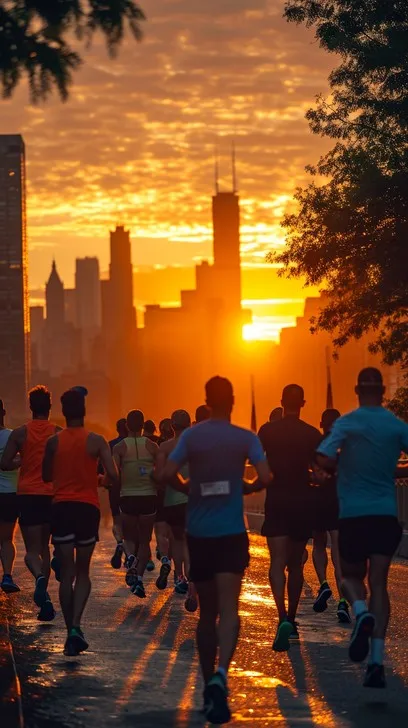
Photo: diverse group running club meeting at sunrise city street, via images.stockcake.com
There was a time when hanging out didn't require planning. You drove to the diner because the diner was there. You drifted through the mall on a Saturday because the food court had air conditioning and your friends had nothing better to do. Nobody sent an invite. Nobody checked a calendar. You just showed up, and other people were also there, and that was the whole point.
That world is mostly gone. The malls are half-empty, the diners have been replaced by drive-thrus, and the corner bar where everybody knew your order has been priced out or poured out. But Americans haven't stopped wanting to gather — we've just gotten weird about how we do it.
The Rise of the Structured Hangout
Look around any mid-sized American city right now and you'll see it: a run club with 200 members meeting at 6:30 a.m. sharp. A chess club packed into the back of a brewery. A climbing gym where strangers belay each other into friendship. Even the grocery store has gotten in on the act — places like Salem, Oregon's community-minded markets or the town-square-style Eataly outposts are designed less for shopping and more for lingering.
What these venues share isn't the activity. It's the architecture of commitment. Every single one of them requires you to decide in advance that you'll be there. The run club has a start time. The book club has a date. The pickup basketball game lives in a GroupMe that you joined on purpose.
Sociologists have a name for the old kind of place — the diner, the barbershop, the stoop. Ray Oldenburg called it the "third place," the spot that's neither home nor work where community happens by accident. The new third places aren't accidents. They're appointments.
Why We Needed the Structure Anyway
Here's the uncomfortable truth: the spontaneous hangout only worked when everyone lived close, worked similar hours, and didn't have a screen offering a more comfortable alternative. That's not the world we live in anymore. Your college friends are in four time zones. Your neighbors work hybrid. The path of least resistance is your couch.
So we outsourced the hard part. The run club removes the negotiation — nobody has to text "what time?" because the answer is always 6:30. The climbing gym gives two strangers a reason to talk that isn't "so, what do you do?" Structure, it turns out, is a kindness. It's a pre-made excuse to show up.
There's real evidence this works. Researchers who study adult friendship consistently find that repeated, low-stakes contact is the single biggest predictor of closeness. Not chemistry. Not shared values. Just showing up at the same time, in the same place, over and over. The scheduled hangout is basically a friendship machine with the variable of awkwardness removed.
What Gets Lost When Friendship Has an RSVP
Still, something nags. The old third places had a quality the new ones can't replicate: looseness. You could show up alone and leave with three people's phone numbers, or sit in the corner and talk to nobody, and both were fine. The mall didn't care if you came.
The new hangouts are more conditional. Miss three run clubs in a row and you start feeling like you're falling behind on a commitment, not skipping a workout. Friendship starts to feel like a subscription you have to maintain. And the people who need community most — the ones with unpredictable shifts, the introverts who can't commit to Tuesday nights, the ones for whom a 6:30 a.m. run is a genuine barrier — can fall through the cracks of a system built around showing up on schedule.
There's also the subtle shift from hanging out to doing. The diner was about nothing in particular. The run club is about running. We've traded ambient togetherness for activity-based togetherness, and some part of the old ease — the ability to just be near people without an agenda — is harder to find.
The Hybrid Future of Hanging Out
The most interesting new spots are trying to have it both ways. Third-space-style cafés with long communal tables and no pressure to buy more than a coffee. Grocery stores with wine bars and patios where shopping takes two hours because you keep running into people. Municipal rec centers running drop-in pickleball, the closest thing we have to a spontaneous hangout in athletic form.
Maybe that's the realistic goal: not resurrecting the diner, but building places where the scheduled and the spontaneous can share a table. Show up for the 6:30 run, stay for the unhurried hour after. Join the chess club, linger past your game.
The third place isn't dead. It just got a calendar invite. Whether that's a downgrade or an upgrade probably depends on whether you're the kind of person who misses the mall — or the kind who never would have shown up without a start time in the first place.