Your Soundtrack Doesn't Belong to You Anymore
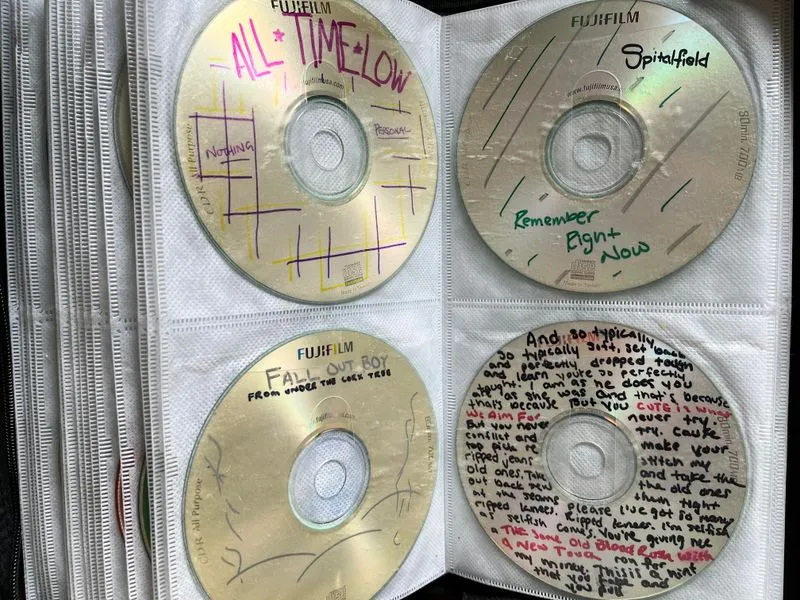
Photo: shoebox of handwritten burned CDs mixtapes nostalgic, via backintimetoday.com
Somewhere in my parents' basement there's a shoebox of burned CDs. Sharpie on the discs, tracklists hand-written on folded paper inserts, the whole thing. I couldn't tell you what's on half of them, but I know exactly who they're from. That shoebox is a museum of a version of me that no longer exists — and, more to the point, it still exists at all.
Your music probably doesn't. Not physically, anyway.
The Great Library Liquidation
Here's the deal we all made sometime in the 2010s: give up ownership, get everything. Sixty million songs, instant, $10.99 a month. Nobody read the fine print, but the fine print was clear — we weren't buying the music, we were renting access to it. And when a licensing deal collapses, songs vanish overnight. Whole artists have disappeared from catalogs because of a contract dispute. Your "liked" playlist is less a record collection and more a reservation.
For most of the 20th century, your music was an object. A record you saved up for. A tape you recorded off the radio, finger hovering over the record button, praying the DJ wouldn't talk over the intro. Every album you owned represented an act of commitment — you spent money, so you listened. Repeatedly. Whether you wanted to or not.
That friction did something. It built relationships with songs.
When Music Stopped Being a Place
The economics changed how we listen. When an album cost $16, you played it until you either loved it or made peace with it — often both. The deep cuts became favorites. You knew the sequencing, the skips, the track that only worked at 2 a.m.
Streaming inverted that. Now the default is the playlist: a mood, a vibe, an algorithmic approximation of what you might like right now. Songs arrive pre-shuffled, decontextualized, interchangeable. Skip rates have skyrocketed because skipping is free. Why sit through track four when track five might be better?
The result is a strange kind of amnesia. Ask a 20-year-old what music shaped them and you'll get artists, sure — but ask them about the album that got them through junior year, the specific song with the specific memory welded to it, and the answers get vaguer. When your soundtrack is a playlist called "chill vibes," the memories attached to it stay vague too.
Identity on a Subscription Plan
There's a deeper problem, and it's about identity. Music used to be one of the primary ways Americans signaled who they were — the band t-shirt, the CD visor organizer, the crate of vinyl that told a date everything they needed to know before the first drink. Your taste was a curated possession, built over years, displayed proudly.
Now your taste lives in an app that could suspend your account. It's legible to Spotify's algorithms but not to the person sitting across from you. You can't lend someone your library. You can't inherit your dad's. The cultural hand-me-down — that record collection your uncle left you, the songs that got passed from sibling to sibling — has no streaming equivalent.
And let's be honest about who benefits. Every playlist you make trains the recommendation engine. Your memories, converted into data, make the ads and the suggestions sharper. We've outsourced our libraries to companies whose incentives have nothing to do with whether we remember the summer of 2009.
Buy the Record. Burn the CD. Whatever It Takes.
None of this means streaming is evil — the access is genuinely miraculous, and there are artists who'd be unheard without it. But the remedy is cheap: buy the albums you love. Bandcamp, Discogs, your local record store's dollar bin. Keep a playlist backup as actual downloaded files. Make someone a playlist with a theme and a title and hand it over like it's 2003.
Because a soundtrack you own is a story you can keep. A soundtrack you rent is a story someone else can cancel. And the version of you that those songs hold — that person deserves better than a licensing dispute.